
In the midst of third wave of COVID-19, Finance Minister Nirmala Sitharaman has come up with an impactful Budget which is balanced, fiscally prudent and growth-oriented, the USA India Chamber of Commerce has said. President of the Boston-based USA India Chamber of Commerce (USAIC) Karun Rishi, however, said it is a matter of concern that the budget lacks tangible measures to increase revenue generation. "Opting to keep the fiscal deficit at 6.9 per cent and increase capital expenditure by 35 per cent is a masterstroke. "The annual budget estimates the effective capital expenditure of Rs 10.68 lakh crore in 2022-23, making up about 4.1 per cent of the GDP," he said. "A phenomenal increase in the government's capital expenditure is likely to facilitate the expenditures on infrastructure and create jobs.

The finance minister may stagger some of the recommendations.

Nothing, according to Deepak Lal. He argues that the contemporary attempts to control immigration in the US and UK are not nativist.
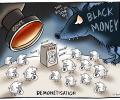
Months before 8/11, MP, Haryana probed note ban

Corporate India at present is more indebted than all state govts put together.

While buying health policies, customers should reveal any pre-existing diseases. This is the only way to ensure that the insurer does not reject claims.

'For a responsible person like him to utter such nonsense is shameful.' 'He is not fit to be a director on the RBI central board.'

The oil crisis could not have come at a worse time for the Modi government as its tax collection has fallen short of its 2020-2021 target by Rs 5.2 lakh crore.
Bankers said the mammoth task of cleaning up the PSBs and improving their health will be a mammoth task for any chief executive.

'If the RBI had done the right things, these mistakes would not have happened in banks, public or private,' says Ajay Shah.

The finance minister asked lenders to identify eligible borrowers and reach out to them and urged for quick implementation of a sustained resolution plan for the revival of every viable business.

The size of the hole in today's banking crisis appears to be roughly 10 per cent of GDP.

The system envisaged under the FRDI Bill, if implemented properly, would help improve the efficiency of capital allocation without harming consumers, and without risking the stability of financial firms, says Ajay Shah.

Last week, a Rajya Sabha committee had allocated five hours for discussion on GST.

Some experts says that the high net-worth requirement of Rs 50 crore for setting up an IU is a deterrent.

'Given the possibility that our unstable northern and western borders may become 'live' at short notice, any major systemic change which impacts combat effectiveness should be brought about in a cautious and progressive manner.'

Politically, it will not be easy for Modi to take hard decisions such as raising fuel prices in the first budget, given the risk of higher inflation.

'Welfare schemes are not a necessary evil, they are a necessary good.'

But it is disappointing to note that Sitharaman's third Union Budget continues to promote a few problematic ideas, observes A K Bhattacharya.
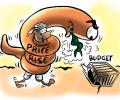
In absolute terms, fiscal deficit went up by 33.6 per cent in April-December 2017 and the revenue deficit by as much as 40.7 per cent compared to the same period the previous year, said Sudipto Mundle.

We are in this mess as the machinery of the government in a market economy is broken. We need technically sound banking regulation, so that capital is not misallocated, and the landscape does not get littered with zombie firms kept alive through evergreening, says Ajay Shah.

The speed at which he led the central bank in different areas -- ranging from internal reorganisation to inflation fighting, stabilising the currency, taking on rogue corporations, cleaning up bank balance sheets, and opening the sector -- makes one believe that Rajan knew he had only three years to do his job. A fascinating excerpt from Tamal Bandyopadhyay's MUST-READ Roller Coaster: An Affair with Banking.

A Parliamentary Standing Committee praised the government for the wrestling and boxing facilities at the Sports Authority of India's Sonepat Center but pointed out that "excellence needs to be replicated for other sports disciplines".

Stepped up public expenditure must be accompanied by focused policies, advises Vinayak Chatterjee.
'We have to stop thinking about GDP and look at the impact on output and unemployment.' 'And that is not going to be insignificant.'
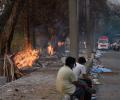
Shortage of ICU beds, oxygen, ventilators, vaccines, doctors, nurses and crematorium space in India has dominated headlines around the world in the past few weeks with Covid-19 cases surging beyond control and the government failing to deliver. Yes, election rallies, Kumbh Mela, blatant flouting of social distancing and mask protocols coupled with a messy vaccination process are said to be responsible for the health crisis of colossal proportions that India is facing today. But an analysis of Budget speeches made by finance ministers over 75 years also offers a glimpse of how low on the priority list healthcare has featured for the political class and policy-makers, which is a significant reason for the current situation.

The branch managers have come out of their glass cabins and the sellers' market has transformed into a buyers' market, but there is no end to the harassment of customers, asserts Tamal Bandyopadhyay.
The panel will also recommend a fiscal consolidation road map for the central and state governments, study the impact of GST on the divisible pool, and propose performance-based incentives for states.

Poor predictability, credibility and effectiveness of fiscal performance have been key reasons for successive governments failing to deliver on their promises.

'We are looking at the Budget with the hope that it will address all issues even at the cost of exceeding the fiscal deficit target.'

'Look at the number of billionaires, the number of new billionaires in India.' 'Adani and Ambani are not the only ones.' 'What's wrong with people making money as long as it benefits us?'

NITI Aayog had been asking for Rs 7,500 crore for three years to set up an AI framework.
'The idea is to have a separate and independent consultation on non-personal data, and decide the contours of how it should be regulated, whether as guidelines, rules, or a separate policy,' said a senior official at MeitY.

The Finance Commission has substantially increased the allocation of funds to panchayats, but a large part of it is apportioned by state governments.
According to the draft, in the northeastern states the threshold is at Rs 500,000.

''Even without major reforms, with a business as usual scenario, and with current inflation trends, we should be clocking around 11 to 12 per cent nominal growth.' 'That is not happening and is a source of worry,' Rathin Roy tells Arup Roychoudhury.

Insurance companies are seeking a separate deduction limit of Rs 1 lakh for insurance premium payment under Section 80C of the Income Tax Act in the upcoming Union Budget to bring in more people under the ambit of insurance. The insurers also want reduction in the goods and services tax (GST) rate of 18 per cent currently applied on health insurance products to 5 per cent to make such products more affordable to common people. Finance Minister Nirmala Sitharaman will present the Union Budget for 2022-23 on February 1.

Govt to chalk out entry of sovereign funds from Abu Dhabi, Qatar into such projects.

According to the NIPFP, there is the possibility that even if the banking system matures over time, some transactions could bypass the system so as not to pay the BTT.

There is money to buy the central public sector enterprises, but buyers will need a firm assurance that the disvestment programme will keep environment issues front and centre of their corporate plans.
